


The Waqf (Amendment) Bill: Politics Meets Legal Reform

In December 2023, speculation arose that the Modi 2.0 government would introduce an amendment bill to the existing Waqf Act. This speculation was followed by the introduction of a private member's bill titled "The Waqf Repeal Bill, 2022," which was tabled in the Rajya Sabha on December 8, 2023, by MP Harnath Singh Yadav. The bill sought to repeal the Waqf Act of 1995.
However, this bill was not pursued further and was eventually removed. Instead, on August 8, 2024, the Minister of Parliamentary Affairs and Minority Affairs, Kiren Rijiju, introduced a new bill titled "The Waqf (Amendment) Bill, 2024." Unlike the earlier private member's bill, this bill aims to amend the existing Waqf Act of 1995 rather than repealing it entirely.

Concept of Waqf -
First, it is important to understand "What Waqf stand for, under Muslim law.”
Under Mohammedan law, a Muslim individual can dedicate or donate property—whether movable or immovable—to Allah. This dedication is religious, pious, or charitable in nature and is characterized by being unconditional, absolute, and irrevocable. Once dedicated, the property (known as Waqf) cannot be gifted, inherited, sold, or mortgaged.
When a Muslim dedicates their property as Waqf, they transfer the absolute ownership of that property to Allah. However, since Allah, as a divine entity, cannot manage the property's affairs, a Mutawalli (manager of the Waqf) is appointed by the Waqf Board. The Mutawalli is not considered the owner or trustee of the property but acts as a superintendent. Their primary responsibility is to ensure that the property is used according to the purposes intended by the Waqif (the person who dedicated the property). It is important to note that once the Waqif dedicates their property, they lose all ownership rights.
Unlike other religious practices derived from the Sunnah (the teachings of Allah), the concept of Waqf is not directly rooted in it. Instead, it is an age-old religious practice that has continued over time, much like Triple Talaq or Talaq-e-Biddat, which are also not rooted in the Sunnah.
The Establishment and Function of the Waqf Board -

Waqf boards have a long history, with some boards existing at the state level even before India's independence. The Central Waqf Council was established in 1964 as a statutory body to oversee the functioning of state waqf boards under the Waqf Act of 1954. The primary role of Waqf boards is to manage properties intended for charitable purposes, such as supporting the poor and needy, maintaining mosques and other religious institutions, establishing educational facilities, and creating shelters, homes, dargahs, and graveyards. This framework operates at both the local state and national levels.
The Ground Reality of the Waqf Boards -
The 1976 Waqf Enquiry Report: The 1976 Waqf Enquiry Report noted significant issues within the Waqf boards, notably that they were often controlled by Mutawallis (managers), leading to inefficiencies and potential misuse of Waqf properties. The report recommended that the government take proper measures to discipline the management of Waqf properties and ensure their proper use.
The Justice Rajendra Sachar Committee Report (2005): On March 9, 2005, the UPA government, led by Prime Minister Manmohan Singh, established a high-level committee under Justice Rajendra Sachar. The committee's primary objective was to improve the socio-economic conditions of Indian Muslims. In its findings, the committee observed that over 4.9 lakh Waqf properties were generating a mere ₹162-169 crore per annum—a figure far below their potential. The committee estimated that if managed efficiently, these properties could generate over ₹1.2 lakh crore annually. As of today, there are more than 8.72 lakh Waqf properties, and their potential income, if utilized efficiently, would be tremendous.
It is worth noting that despite the Muslims being one of the major beneficiary of numerous current government welfare schemes, Muslims remain one of the most underdeveloped communities in India - and many term the current government as fascist and hostile towards minorities.
There are approximately 32 Waqf Boards in India, with around 200 individuals responsible for administering over 8.7 lakh properties, wielding significant authority with minimal oversight. These boards operate with substantial autonomy, as many states lack the necessary tribunals to regulate their actions. Even in states where tribunals exist, the scope for appeal is severely limited, requiring aggrieved parties to file a writ petition in the High Court to seek redress.
Baffling Instances Regarding Waqf Land -
Anand Ranganathan, a right-wing intellectual, discusses the Waqf board extensively in his book Hindus in Hindu Rashtra. He notes that the Waqf board is the third-largest landowner in India, after the Defence Ministry and Indian Railways. Much of its holdings date back to pre-independence times. Waqf lands include significant properties such as the Delhi High Court, the Central Vista project (which includes the new Parliament building), the CGO Complex, Jawaharlal Nehru Stadium, and an astonishing 77% of Delhi. Even Mukesh Ambani's residence is reportedly on Waqf land.
One of the most striking aspects of the Waqf management system is its motto:
"Once Waqf, Always Waqf."
In one of the more absurd instances, the Uttar Pradesh Sunni Central Waqf Board once claimed that the Taj Mahal belonged to the board, declaring it as a religious Waqf property. In 2005, the board registered the Taj Mahal as a Waqf property, which led the Archaeological Survey of India (ASI) to approach the Supreme Court and obtain a stay on the registration order. This stay has been in place ever since.

During one of the hearings, the Chief Justice of India (CJI) questioned the Waqf Board's claim and asked it to produce documentary evidence showing that the Mughal Emperor Shah Jahan had designated the Taj Mahal as Waqf property. The CJI humorously remarked, "Show us the title deeds. It would be interesting to see the handwriting and signature of Shah Jahan." To date, the board has not been able to provide such documents, leaving the case unresolved and casting doubt on the legitimacy of the board's claim.
Timeline of the Waqf Act -
In 1954, Prime Minister Jawaharlal Nehru introduced the Waqf Act as part of an effort to centralize the administration of waqf properties in India. One of the primary objectives of this act was to manage the properties left behind by Muslims who had migrated to Pakistan during the partition. The government brought these evacuated properties under the purview of the Waqf Act, allowing them to be managed according to the principles of waqf.
In 1995, Prime Minister P.V. Narasimha Rao introduced amendments to the Waqf Act. These amendments were seen as an effort to regain the support of Muslim voters following the Babri Masjid demolition in 1992. The revised act granted extensive powers to the Waqf Boards, allowing them significant autonomy in managing waqf properties. The implications of these powers are discussed in detail later in the article.
Before the 2014 elections, the outgoing UPA government proposed to transfer 123 prime properties in central Delhi to the Waqf Board. This proposal was seen as an attempt by the Congress party to secure the support of the Muslim community.
Proposed Changes and It's Reasoning -
Verification of Proof of Ownership:
The proposed amendments empower the District Collector as the primary authority in determining whether a piece of land can be classified as waqf property. This marks a shift from the previous provision where the Waqf Tribunal held this authority.
Introduction of the Valid Waqfnama:
A new requirement for a valid Waqfnama (official deed) has been introduced. This document will serve as a testament to the intention of dedicating the property as waqf. Under the current law, oral agreements are allowed, but the amendment seeks to formalize these arrangements through written documentation.
Inclusion of Female and Non-Muslim Members:
The composition of the Central Waqf Council and State Waqf Boards will be altered to include two female members and two non-Muslim representatives. Previously, these bodies were entirely male. The Minority Affairs Minister has stated that these appointments will not be random but it will be Members of Parliament, who work for public welfare.
Judicial Intervention:
The amendments open the scope for judicial intervention, particularly concerning litigation under Section 40 of the act. Currently, if the Waqf Board believes that a property is waqf property, it can independently initiate an inspection and inquiry without needing to justify its belief. If the person residing has objection, he/she should approach the Waqf Tribunal, however, the burden of proof rests on the person residing on the property to prove that it is not waqf property. The Waqf Board has extended it's authority to issue notices to the Tehsildar (land revenue officer) to prevent the sale or mortgage of waqf land without a No Objection Certificate (NOC) from the Board. However, it is noted that obtaining an NOC from the Waqf Board is nearly impossible in most cases.The tribunal's orders are final and binding, with no appeal option, except for filing a Special Leave Petition, which is both financially and psychologically draining. S.40 of the act was introduced in 1995 as above-mentioned (by the then-P.V Narasimha Rao Govt.) S.40 has now been abolished.
Audit of Waqf Properties:
The amendments grant the central government the authority to initiate audits of waqf properties through auditors appointed by the Comptroller and Auditor General (CAG) of India. Previously, audits were conducted internally. The government aims to address the mismanagement of funds through this provision.
The rejection of the claim of daughter's inheritance rights in certain cases has been addressed in the newly proposed amendment to the Waqf Act. Traditionally, some Muslim men have denied inheritance rights to their daughters by designating their property as Waqf-alal-aulad—a specific form of Waqf where the income from the dedicated property is reserved for the family members, such as sons, rather than for public charitable purposes. This practice was often used as a loophole to bypass Islamic inheritance laws, which mandate that daughters receive a share of the inheritance.
However, with the introduction of Section 3A in the Waqf (Amendment) Bill, such denials of inheritance rights under the guise of Waqf-alal-aulad can no longer be justified. The new provision explicitly prohibits the use of Waqf as a tool to deny daughters their rightful share of the inheritance. This change ensures that daughters' inheritance rights, as prescribed under Islamic law, are protected, and cannot be overridden by the creation of a Waqf dedicated solely to male heirs. This reform brings greater clarity and equity in the treatment of family members within the framework of Waqf.
Criticism of the Proposed Amendments -
The proposed amendments have faced criticism from several political parties, including the Communist Party of India (Marxist), All India Muslim Personal Law Board (AIMPLB), Samajwadi Party, and Asaduddin Owaisi's All India Majlis-e-Ittehadul Muslimeen (AIMIM). These parties argue that the amendments undermine the autonomy of waqf institutions and interfere with minority affairs, which they believe goes against the constitutional rights of the community.
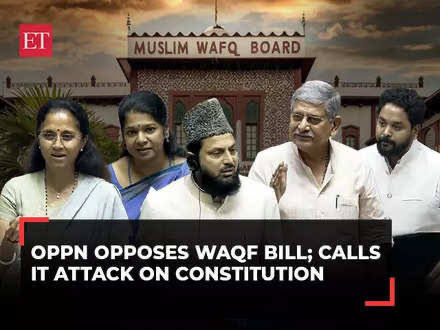
The opposition members cited Indian constitution that proposed amendment violates article 25 and 26, which is regarding , however, the government rebutted disclaim that first of all the WAQF board does not violate article 2526 act. It is a statutory body, not a representative body of Muslims or a religious denomination.
The opposition, however, is silent on the matter of corruption, encroachment, and land grabbing by numerous WAQF boards. It is true that the Constitution ensures a religion is given the freedom to function the way it wants to be. However, it should be in till the time, religion does not encroach upon another religion, faith or another persons right till then the functions cannot be challenge of question, but if it did, the state has to interfere if it is not the state who will interfere regarding the the scene, one, example of encroachment and violating others fundamental right is one of the instances in Tamil Nadu, where the Waqf board claims ownership of an entire village, which that is Hindu maturity the work forced to convert the religion to keep the village intact with the members of Hindu community. Another instance is when was claimed stake on two islands in Bet Dwarka, which is Lord Krishna's. However, that "asked when did Lord Krishna waqf-ed the disputed stake on the two islands concluding in rejecting the Waqf's claim.
Another instance includes in Tamil Nadu, where the board claimed that 18 Hindu majority villages in Trichy and a more than 1500 year old temple is on waqf land
Political Will behind the Bill -
Any legislation introduced by a government that disregards the political dimensions surrounding it is fundamentally flawed. This is especially true when the legislation concerns a specific religion or community.

During the election campaigns, Prime Minister Modi stated that every minister would present a 100-day roadmap outlining their policies and new legislative proposals. This declaration seemed aligned with the BJP’s previous track record, such as in 2019 when the party swiftly moved to abolish Article 370 shortly after returning to power. Ahead of the recent elections, there was widespread speculation that the BJP might introduce a Uniform Civil Code, implement a nationwide one-election policy, or amend the Places of Worship Act of 1991. However, such speculations are typically prevalent before election results are announced.
Now, the BJP is back in power, albeit with fewer seats, reduced to 240 MPs, forming an alliance to secure its position. In this context, passing politically controversial bills seems increasingly unlikely, particularly after the elections.
Nevertheless, there is pressure from the BJP’s core voter base, which expects further steps toward a Hindutva-driven agenda. Despite this, the BJP had to send the Waqf (Amendment) Bill to a Joint Parliamentary Committee. The term “forced” is used here to highlight that over the past decade, the BJP has rarely consulted opposition parties in its decision-making process. The party’s “Sabka Vishwas” mantra now seems ironic.What is particularly noteworthy is that the Waqf agenda was not explicitly mentioned in the BJP’s manifesto. However, the introduction of the Waqf (Amendment) Bill seems to underline a subtle political message to the BJP’s core voter base: despite being part of a coalition government, the BJP remains committed to its core agendas, including reforms that resonate with its ideological stance.
Another issue is the BJP’s failure to engage the Muslim community, where reforms like the Waqf (Amendment) Bill might have been seen as progressive. The situation is further complicated by statements made by BJP state leaders such as Himanta Biswa Sarma and Yogi Adityanath, whose controversial remarks, including those linked to “bulldozer politics,” have only deepened the divide.

The fundamental issue with the current Modi 3.0 government, or the NDA government at large, is the perception that every piece of legislation where Muslims are stakeholders is considered anti-Muslim. The BJP is often seen as targeting Muslims through its policies. A significant part of this perception stems from the lack of Muslim representation within the BJP to engage with Muslim stakeholders.Notably, there isn’t a single Muslim Member of Parliament (MP) in the BJP who could act as a bridge between the party and the Muslim community in India.
One of the most prominent Muslim faces within the BJP was Mukhtar Abbas Naqvi, who has been a part of Parliament since the Atal Bihari Vajpayee era, boasting over 25 years of parliamentary experience and having held significant ministerial positions across various Indian governments. However, in the most recent elections, he was not even given a ticket to contest, symbolizing the party's growing detachment from Muslim representation. Politics is heavily influenced by optics, yet the BJP, even for the sake of optics, has not opted for a single Muslim MP.

Another critical aspect to consider is the possibility that the introduction of the Waqf (Amendment) Bill could be an effort to reconcile the relationship between the BJP and the Rashtriya Swayamsevak Sangh (RSS). Under Prime Minister Narendra Modi, the BJP has operated with absolute autonomy. Over the past ten years, the RSS has granted the central leadership, primarily Modi and Amit Shah, a free hand to manage both the party organization and the government with minimal intervention. Previously, the RSS played a more active role as the ideological and spiritual guide behind the BJP's decisions.
However, the 2024 general election results, which saw the BJP reduced to 240 seats and forced to seek alliances to form a majority, have caused friction between the RSS and the BJP. The once-promised "Abki Baar 400 Paar" (This time, over 400 seats) slogan failed to materialize, leading to a re-evaluation of strategies. The RSS, which had previously taken a backseat, is now more interested in asserting its influence, particularly regarding control over the party affairs. Many believe that, this bill could be seen as an attempt to align with the RSS's broader intellectual agenda.

Conclusion -
The propose changes to the existing provisions of Waqf Board are sensible and overdue, given the failure of self regulation and stronger regulatory mechanism the bill can be loaded in its proposed efforts to combat the above mentioned problems. How the implementation is to look forward to. the Waqf has worked with no oversight or autonomy. Uncanny Parallel can be drawn that the Hindu temples are well within the control of the government with almost minimal autonomy. This has been qualitative of the principles of secularism that the preamble of the Constitution claims it to be, however, this has been changed sought to be changed by the proposed changes, in almost every country specifically, the Muslim dominated countries has not given so much autonomy to the WAQF board, however, for the sake of secularism and the facade of minority has perpetuated the ultravires, autonomy and authority of the board. For example, Kuwait and Singapore has applied modern management technique and kept transport transpare, many countries that is Muslim have centralised and digitised their waqf management system, for example - Even Saudi and Oman did not give absolute power to a single Muslim entity.
What is more baffling that the social economic position of Indian Muslims is considered to be very low in Bharat however, how rich are these Muslims that there has been more than 8,72, 000 properties under the waqf.


Comments