


L.K. Advani : The PM , India Never Witnessed


In the dynamic realm of Indian politics, few names carry the same weight and influence as Lal Krishna Advani. As a stalwart of the BJP Advani's remarkable career spanning over two decades has left an indelible mark on India's political landscape. Advani is remarked as a person who took BJP from 2 seats in the 1984 elections to 85 seats in the 1989 elections. This article delves into the potential moments when Advani stood on the brink of being crowned as India's Prime Minister.
1] Chaos and Chants in Shivaji Park, 1995 -
A public rally has been scheduled in Shivaji Park in Mumbai, with over 120,000 people expected to attend. This address holds immense importance as it is anticipated that L.K. Advani will announce his name as the party's prime ministerial candidate for the upcoming general elections in 1996.

The event began with electrifying speeches on electoral success and the importance of cadre unity. Even Atal Bihari Vajpayee, who had been sidelined by the party due to his moderate image, delivered an address. The day would conclude with a speech from the party president, L.K. Advani. During his speech, Advani made promises to the people and highlighted the achievements of various State BJP governments in power. He concluded with the statement , "देश पिछले कुछ बरस से chorus में एक नारा सुन रहा है, अबकी बारी अटल बिहारी". He continued, "This is the moment where, as the BJP Party President, I announce Atal Bihari as the BJP's prime ministerial candidate for the 1996 general elections."
This announcement came as a shock to the crowd and all the party leaders who shared the stage with Advani. Nobody had prior knowledge of this, not even Atal ji. After a few seconds of silence, a small section of the crowd started chanting "Vajpayee, Vajpayee." Some remarked that these chants wouldn't have arisen without Advani's knowledge, suggesting that he had full control over the party.
Surprised and taken aback, Atal asked him, "ये क्या कर दिया आपने, मुझसे तो पूछ लिया होता"
With utmost clarity, Advani responded, "यदि आपसे पूछता तो क्या आप मानते ?".
Advani took this decision unilaterally, without consulting the Sangh or BJP. But Sangh Parivar was adamant about pushing Advani's name. Nevertheless, the party went into election mode under the leadership of Atal Ji as their PM.
Advani understood the dynamics involved in coalition politics, recognizing that the 1990s was an era of coalitions. During this period, no single party could emerge as the single largest party, instead relying on coalition partners to form a government. Advani astutely acknowledged that a leader capable of fostering consensus among these partners was essential to the smooth functioning of the alliance. However, Advani knew that he may not be the ideal figure to lead such a coalition. His reputation as a polarizing leader would likely have resulted in a short-lived journey for any coalition partners aligning themselves solely with BJP.
2 ] Political Blunder in Pakistan -
After the failure of the highly-ambitious "India Shining" campaign in the 2004 general elections the party, Vajpayee could never formally crown Advani as his successor to the PM chair but his deteriorating health opened the way for Advani to take sole control of the party as Atal Ji began to withdraw himself from active politics. This led a newly elected party president Advani to steer the party in a new direction and he chose the WORST possible direction to take it - To Pakistan with LOVE.
For Advani, his visit to Pakistan in 2005, was him revisiting his birthplace and reflecting on his journey from being born as a Sindhi in united India to being forced to move out, only to ascend the political ladder of prominence. He returned to his hometown of Karachi, where he paid homage at the mausoleum of M. Jinnah and hailed the chief architect of the two-nation theory as "an ambassador of Hindu-Muslim unity."
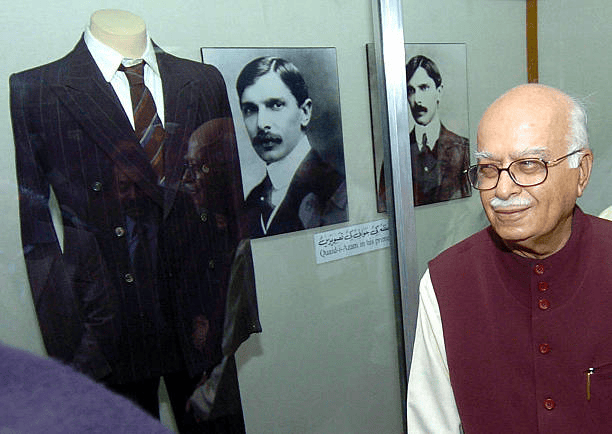
This marked a new phase for Advani, as he attempted to embrace a more secular and liberal stance. Previously, the party could present contrasting images, with Atal Ji representing a liberal side while Advani projected an assertive Hindutva image. However, with Atal Bihari
no longer in the picture, Advani sought to shed his " HINDUTVA POSTER BOY " persona to garner acceptance from all sections of society, much like Atal had done.
With his visit and problematic statements - he angered the Sangh, party cadre did not fully trust him with his changed tone and behaviour, VHP leaders labelled Advani as a “traitor”, his loyalists like Sushma Swaraj and V.Naidu were unwilling to endorse his statement, likes of Yashwant Sinha and Kalyan Singh demanded Advani to quit as Leader of the Opposition. Here, I notice a structural problem [dicotomy] with the Sangh Parivar, it needs a hardliner ideologue for its cadre but the same person when has to get a consensus of the people for the most respected post in the country, he/she is not allowed to portray a mellow non-partisan image. A Prime Minister is not a leader of Hindus but equal to all other minorities living in our country.

The problem Advani would face is his indelible image which was deeply ingrained in people's minds with someone "leading the rath yatra", a "person who stands for Hindutva",
"a leader who aims for Hindu Rashtra" etc. Later that year, Rajnath Singh was chosen as party president as Advani was forced to resign.
In the year 2009, Advani's selection as the face of the BJP for PM candidate reflected the party's decision to rely on his experience and seniority. However, his declining popularity among the electorate suggested a shift in public sentiment and a disconnect between Advani and the voters with the Jinnah episode, damaging core votes of the BJP.
3 ] Rise of Modi, Fall of Advani

Before the Lok Sabha elections of 2014, a strong anti-Congress sentiment prevailed among the people. Advani felt confident that the party would emerge victorious until Gujarat CM Narendra Modi started preparing for a larger role and positioning himself as the leader who could guide the party to success. Arun Jaitley took the initiative to garner support for Modi's candidacy, persuading key figures such as the RSS, Rajnath Singh, V. Naidu, and Nitin Gadkari.
In 2013, a party meeting was held in Goa to announce Modi as the BJP's prime ministerial candidate for the 2014 general elections. Advani chose to skip the meeting, which was interpreted as an attempt to hinder the announcement by expressing his disapproval through his absence. This marked the first time he had missed a national executive meeting.
It was clear within the party about Advani's inability to accept the success of his political apprentice. Despite this incident, Modi went on to become the party's PM candidate.
Advani announced that he was resigning from all party positions which was seen as a clear indication of his dissatisfaction. Advani stood for his unfinished desires and it may be possible that due to the factor of mentor-mentee, he lived in past and couldn't understand the present reality that MODI was no more a protege but a widely-accepted PM material in cadre and sangh. He
Over the following years, as Modi gained popularity nationwide, Advani grew increasingly silent. It was too late for him, as later one could see him greeting and welcoming Modi at events and ceremonies as if a protege greets a veteran leader. Modi would often ignore him as if he didn't notice his presence and greetings.

Unfortunately, Advani did not have the opportunity to receive a graceful exit or a grand farewell which would match the stature of the leader he was. Later in his career, he aspired to attain the position of President, hoping to conclude his political journey with that prestigious role. However, his dream was shattered when the high command overlooked him and instead chose Ram Nath Kovind as the presidential candidate for the elections. It was reminiscent of the situation faced by Pranab Mukherjee, who was tagged as a "PM in waiting". However, he was fortunate enough to become the President, thereby achieving a significant position in his political journey. Advani, on the other hand, faced disappointment as his desire to become the President remained unfulfilled. The high command did not care to politically adjust.
Later, the Gandhinagar Lok Sabha constituency underwent a reallocation, which was given to Amit Shah, who would later assume the position of the Home Minister. Notably, this was a position that Advani himself had once held in Atal Bihari Vajpayee's cabinet.
Conclusion -
Throughout his political career, Advani carried the burden of being remarked as the "PM-in-waiting," a title he never managed to attain. His life serves as a quintessential example of how the past can resurface to haunt a person. The Babri demolition incident proved to be a significant obstacle, preventing him from assuming the role of Prime Minister back in 1996. Additionally, his visit to Pakistan posed problems in 2009 and later in 2014.
In contrast to other leaders such as Sushma Swaraj, Rajnath Singh, Arun Jaitley, and Nitin Gadkari, Advani miscalculated and found himself sidelined in the party due to his inability to adapt and stand behind in the political queue.
However, during his tenure as an MP from 2014 to 2019, despite his disappointment and a tinge of anger, Advani, unlike Yashwant Sinha and Arun Shourie, showed unwavering loyalty to his party and refrained from adopting an anti-party stance or openly criticizing its policies. Despite not being politically accommodated, he understood the significance of his role in building the BJP from the ground up. His commitment to the party remained steadfast as he recognized the immense effort and dedication that went into shaping the BJP's foundation.
Sometimes I ponder whether Advani regrets his decision to back Modi when there was immense pressure to remove him after the Godhra riots. Does he regret that he tactically intervened by pressuring Atal Ji, who was adamant that Modi should step down from the Chief Minister position?

A profound quote reminds us that
" Greatness transcends mere positions and lies in the impact one has on the lives of others"
Considering this, it is plausible to hope that Advani finds some contentment in seeing that he shaped leaders -Narendra Modi, at the helm as Prime Minister, Rajnath Singh, Arun Jaitley, Sushma Swaraj, Venkaiah Naidu. While Advani's personal feelings remain unknown, it is hopeful that witnessing his once proteges lead in their respective fields brings him a sense of fulfilment and pride in their collective contributions to the nation.


Comments