


War, Ego, and the Collapse of America in the Iran Conflict


The Nature of Victory: A Political, Not Military, Concept
"Victory is not a military term". Victory is, and has always been, a political construct. The outcome of any war must therefore be assessed not by counting destroyed facilities or eliminated generals, but by asking a single question: who achieved their political objectives?
Iran, despite suffering enormous material losses, emerges with a political victory. Israel achieves a tactical victory at the cost of a long-term strategic disaster. The Gulf Cooperation Council (GCC) walks away as perhaps the most unfairly victimised party of the entire episode. And the United States which is indeed the most powerful military in human history emerges humiliated on the global stage. Military power, when divorced from clear political objectives, produces not victory but expensive stalemate.
The origins of the current conflict trace back to 2025, when Israel launched what it as a surgical campaign which was a precision operation targeting Iran's nuclear infrastructure and its ballistic missile programme. In terms of operational execution, the 2025 campaign was a near-textbook success. Facilities were degraded, command structures were disrupted, and the drone and missile development ecosystem was significantly damaged.
2026 and the Trap: How Trump's Ego Became a Strategic Liability

By 2026, the strategic architecture was in place. Israel resumed strikes on Iran, this time with the United States joining as an active partner. The justification was completing what the 2025 campaign had started, totally finishing the work on Iran's nuclear programme and, as the war objectives increasingly revealed, something approaching regime change. But the entry point for the Trump administration's escalation was not strategic necessity. It was ego.
Donald Trump, having watched the 2025 campaign from the sidelines as a political success story, could not resist the opportunity to claim a defining legacy moment. Trump, a leader whose entire political identity is constructed around the projection of dominance and the claiming of credit.
The historical parallel that comes to mind is Hitler's early victories such as the remilitarisation of the Rhineland, the Anschluss, the fall of France, created a sense of overconfidence in him a conviction of invincibility that led directly to the catastrophic miscalculation of Operation Barbarossa that is the attack on Soviet Union. Trump's own early political victories such as the Abraham Acoords, the Venezuela episode appears to have produced a similar cognitive distortion.
Shifting War Goals: The Deadliest Strategic Sin

One of the most damaging and consistent features of American military adventurism since Vietnam has been the phenomenon of shifting war objectives. It is a disease that has infected every major conflict the United States has prosecuted since the Cold War till the Iran campaign.
The war began with a stated objective that was specific and arguably defensible: the elimination of Iran's nuclear weapons programme. But as the conflict progressed, the objectives migrated. Regime change entered the conversation, first in think-tank circles, then in political rhetoric, and finally in operational planning. The language shifted from "denuclearisation" to "transformation" to something approaching "liberation."
When "make Iran great again", Trump's post-regime-change reconstruction was floated as a positive vision. That moment was also the high point of American strategic communication in the entire conflict. Its subsequent abandonment which was Trump's declaration that he would "wipe everyone in Iran" destroyed whatever moral high ground the United States had attempted to occupy. The moment an American president makes undifferentiated threats against an entire population, the moral architecture of the enterprise collapses. How is DT different from Khamenei? Military intelligence, however superior, cannot compensate for the complete bankruptcy of political intelligence. Technology wins battles but, credibility wins wars.
Scorecard: Who Won, Who Lost, and Why (as of 15th April)
Iran: The Political Victor

Iran has suffered extraordinary material losses in this conflict. Its nuclear facilities have been severely degraded. Key military and political leadership has been eliminated. Its conventional deterrent capability has been reduced. Iran has been badly hurt. And yet, Iran is the political victor of this conflict and the reasons are structural, not sentimental.
First and most consequentially: Iran has survived. The explicitly stated or implied objective of the combined Israel-US campaign was the termination of the Islamic Republic as a governing entity. Iran endured. Second, Iran has emerged from this conflict with something it did not possess before, effective sovereignty over the Strait of Hormuz.
Prior to the war, Iran's claims to authority over Hormuz were contested. Now, Iran has begun levying taxes on all transit through the Strait, a right it did not previously exercise and which was not previously acknowledged. If these taxes are maintained at even a fraction of the volumes that transit Hormuz, the financial implications are staggering. Conservative estimates suggest Iran stands to collect between $4.5 billion and $5 billion monthly in transit taxes which is approximately $60 billion annually. This revenue, generated from the very conflict that was supposed to cripple Iran, partially offsets the economic damage of the war itself. Iran has converted a military vulnerability into an economic and geopolitical instrument.
Israel: Tactical Victory, Strategic Disaster

Israel's balance sheet in this conflict is the most paradoxical of any party involved. On tactical grounds, Israel's campaign was a genuine success. Iranian nuclear facilities were destroyed. Leadership structures both, political and military were decapitated. The missile and drone industrial base was degraded. Israel's own energy security was entirely unaffected, because no Gulf state supplies energy to Israel in any form. Israel achieved its tactical objectives.
But the tactical victory is already curdling into strategic disaster, and the mechanism of that disaster is located not in the Middle East but in the United States. Israel's favourability in American public opinion has undergone a collapse. In 2022, polling showed approximately 45% of Americans held an unfavourable view of Israel. By 2026, that figure has risen to approximately 65%. The war, and particularly its optics, have accelerated a process of disenchantment that was already underway among the broader electorate.
The consequence, is that Tel Aviv is losing Washington. The pro-Israel consensus that has defined American foreign policy since at least 1973 which is built on the dual pillars of public sympathy and the institutional influence of the Israeli lobby is fracturing. No future American president will be able to commit the political capital to Israel that Trump committed in this conflict. Israel, in securing a tactical victory, has potentially ended the era of unconditional American strategic backing.
The GCC: The Most Wronged Party
The Gulf Cooperation Council which consists of Saudi Arabia, UAE, Qatar, Kuwait, Bahrain, and Oman has emerged from this conflict as perhaps the most unjustly treated parties in the entire episode. They were not consulted before the war. They were not warned that strikes were imminent. They were simply expected to absorb the consequences.
The fundamental strategic reality is this: there are no Israeli military bases in GCC territory. The GCC had no institutional stake in this conflict. And yet GCC states were targeted. The message sent to Gulf leaders was American military action does not guarantee your safety. In fact, proximity to American strategic interests makes you a target.
Had the United States not entered the war, GCC states would in all probability have been safe. Iran has no strategic interest in attacking the Gulf in the absence of American military involvement. The GCC paid the price for a war it never consented to, never benefited from, and was never honestly briefed on.
The United States: Catastrophe

What the United States sought to achieve in the Iran conflict can be summarised as follows: the elimination of Iran's nuclear programme, followed potentially by regime change, followed potentially by a transformed strategic landscape in the Middle East favourable to American interests. What the United States achieved was none of these things.
The nuclear programme has been set back, but it has not been eliminated. Regime change has not occurred. The strategic landscape in the Middle East has been transformed but against American interests, not in favour of them. Iran now controls the Hormuz tax revenue. and American credibility in the Gulf has been shattered. The ceasefire, when announced, had already begun to collapse before the ink was dry, Israel has started attacking Lebanon again before the ceasefire declaration had cleared the 24-hour news cycle.
The list of conflicts in which America achieved short tactical victories while failing to achieve its political objectives is long: Vietnam, Lebanon 1983, Somalia 1993, Libya 2011, Afghanistan 2001–2021, Syria. Iran now belongs on that list.
The deeper damage, however, is to American global prestige which is the invisible currency that funds hegemony. America's Gulf interests which includes its energy security arrangements, its basing rights, its role as the security guarantor of the region have all been damaged. That damage has direct implications for global American hegemony, because the Gulf is not merely a regional theatre. It is the energy fulcrum of the global economy. Diminished American credibility in the Gulf reverberates in every capital that calculates its security arrangements against the backdrop of American reliability.
The JCPOA Ghost and the Diplomatic Void

The JCPOA, concluded in 2015 under the Obama administration, was a genuine diplomatic achievement however imperfect. It placed verifiable constraints on Iran's nuclear programme in exchange for sanctions relief.
Its fundamental flaw, and the flaw for which the Obama administration must bear primary responsibility, was the exclusion of Israel as a stakeholder. Israel's security concerns that is nuclear threat from a state that had explicitly called for its elimination was treated as a complication to be managed rather than a legitimate interest to be incorporated. The result was a deal that Israel had every incentive to undermine, and which it duly did.
The Trump first administration withdrew from the JCPOA in 2018, a decision that, if Israel was not a stakeholder in the deal then the deal was structurally incomplete. The Biden administration, which came to office promising to restore the JCPOA, spent four years blaming Israel for the sabotage of negotiations and then failed to do what four years of majority governance actually permitted it to do: legislate American entry into the agreement as a binding legal instrument, placing it beyond the reach of executive reversal.
The JCPOA was, at its core, a terrorism and sanctions instrument dressed in the clothes of a nuclear negotiation. The distinction matters because a purely nuclear deal that ignores the network of Iranian proxy activity ie: Hezbollah, Hamas, the Houthis, the various Iraqi militia addresses only one dimension of the Iranian threat.
The Islamabad Talks and the Pakistan Question
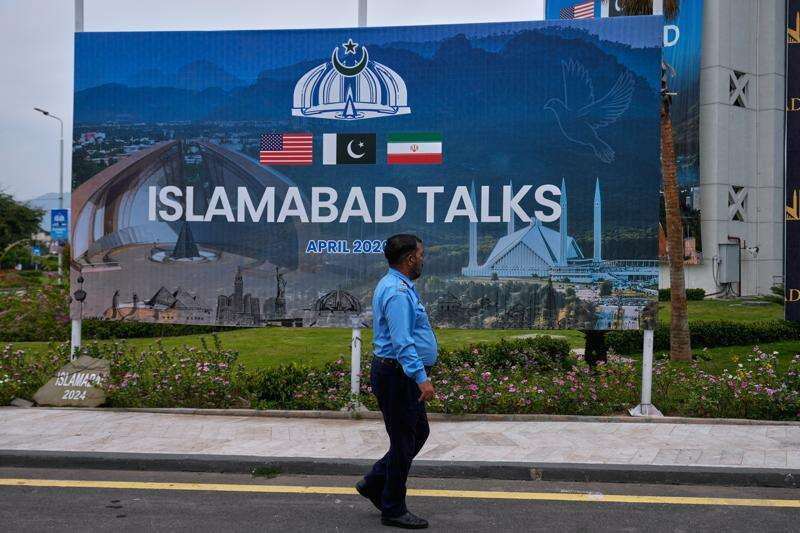
Into this diplomatic void stepped Pakistan, positioning itself as the mediator and host of the Islamabad talks negotiations between the United States and Iran intended to produce a ceasefire framework. The choice of Pakistan as mediator is, at one level, explicable however it is mere facilitator not a mediator. Pakistan maintains an embassy in Washington that functions as the diplomatic representative of Iran's interests in the United States, while the Swiss embassy in Tehran handles American interests in Iran. Pakistan thus occupies a rare structural position: it has direct communication channels to both parties at a moment when those parties have no direct channels of their own.
However, the selection of Pakistan as mediator in 2026 is paradoxical. Pakistan's Defence Minister, Asif Khwaja, has openly and publicly threatened both Israel and Bharat in the period immediately preceding and during the talks. A mediator who publicly threatens one of the parties to the conflict is not, by any conventional definition, a mediator, they are a partisan actor playing the role of facilitator for reputational and diplomatic gain.
Former US Defence Adviser Colonel Douglas McGregor captured the absurdity by saying giving Pakistan the right to mediate this conflict is like asking a pickpocket to hold your wallet while you tie your shoelaces.
The Islamabad talks were additionally undermined by a confusion that may have been structural rather than accidental. Three distinct versions of the proposed framework appear to have existed simultaneously: the ten-point proposal as Iran communicated it to the United States; the version that Pakistan conveyed to Iran from the United States; and the version that Iran presented in public media. These were not minor variations, they were substantively different documents. A negotiation in which the parties cannot agree on what is being negotiated is not a negotiation.
The American delegation's composition reinforced this impression. Steve Witkoff, Jared Kushner, and JD Vance are political operators of considerable skill. They are not, however, technical specialists in uranium enrichment, nuclear verification protocols, or the intricate engineering requirements of a credible denuclearisation framework. Sending a team of political advisers to conclude a technically complex nuclear agreement is bad optics.

A critical point of contention in the talks was Lebanon. Israel's simultaneous and ongoing strikes on Lebanon were never incorporated into the American negotiating framework because, as JD Vance's team argued, Lebanon was not part of the agreement as the Americans understood it. Iran's ten-point proposal which was circulated in media by Iran, however, explicitly included Lebanon. The result was a ceasefire that America declared but that excluded the theatre that Iran considered most central to the conflict.
This was evident when JD Vance returned from Islamabad empty-handed, with the talks collapsing without agreement. In response, Donald Trump reverted to public threats and escalatory rhetoric, including the imposition of a naval blockade in the Strait of Hormuz. Crucially, Israel was not meaningfully bound by the ceasefire framework, as the United States and Israel both maintained that the agreement did not extend to Lebanon. Israeli operations therefore continued in Lebanon, targeting Hezbollah despite the broader ceasefire with Iran.
Bharat's decision not to position itself as a mediator, has been the subject of some criticism, particularly the framing that India's non-involvement represents a diplomatic loss in comparison to Pakistan's hosting role.
This framing is almost entirely wrong. India has strong and multi-directional relationships with Iran, the Arab world, Israel, and the United States. Precisely because these relationships are valuable, India has no interest in compromising them by inserting itself into a ceasefire process that was structurally compromised from the outset. There is no compromise that Bharat could have offered that would have satisfied all parties, and there is no neutral ground on which India could have stood. Bharat's diplomatic capital is better preserved by remaining outside a failed process than by presiding over it. Pakistan's association with the talks, conversely, is a short-term optics victory but a long-term credibility question. The only diplomatic setback Bharat faces is the association of the language of peace with Pakistan
The Endgame: Trump's Three Paths and None of Them Good
As of mid-2026, the conflict shows no signs of resolution. The ceasefire has effectively collapsed. Israel is striking Lebanon and Iran has resumed retaliatory operations. The Gulf states are building diplomatic distance from Washington at a pace that should alarm American strategists. China has increased its involvement, supplying weapons systems through the China-Pakistan Economic Corridor during the ceasefire period, while also playing an informal mediation role driven by its interest in Iranian oil supplies.
Trump faces three options, and all three carry significant costs.
The first option is a negotiated diplomatic settlement: a deal that ends hostilities and freezes military operations in exchange for verifiable Iranian commitments on the nuclear programme. The problem is that the Islamabad talks have failed, the ceasefire has collapsed, and Trump has spent the post-ceasefire period engaged in public threats against Tehran. The credibility required for a successful negotiation has been substantially depleted. Additionally, any deal that does not include Israel, and none can fully satisfy Israeli demands while Iran’s proxy network remains intact will face immediate contestation in Washington.
The second option is escalation: ground operations in Iran. This is a high-risk, high-cost strategy that would invite Iranian asymmetric resistance across the region and potentially draw in Russia and China as counter-balancing actors. Iran’s demonstrated capacity to absorb external military pressure suggests that such an operation would likely produce a protracted, casualty-intensive conflict with uncertain domestic support.
The third option, and perhaps the most likely, is strategic drift: allowing the conflict to continue without decisive escalation or resolution. This is the path of least resistance in the short term and the greatest damage in the long term. A president who enters a war without clear objectives, shifts those objectives mid-campaign, announces a ceasefire that collapses, and then fails to impose strategic direction does not merely fail in foreign policy, he demonstrates to both adversaries and allies that American commitments lack coherence and cannot be relied upon.
Trump's three options in Iran are all bad. The question is only which kind of failure he chooses.
Conclusion: What History Will Record
The Iran conflict of 2025–2026 will be studied not as a model of success, but as a lesson in how a dominant military can win battles yet lose strategically.


Comments