


Why Bharat Cannot Ignore the Pakistan–Taliban Confrontation ?


In 2021, when the United States of America (USA) withdrew from Afghanistan after two decades of war, Pakistan appeared to be the only country that publicly welcomed the development. The, then Prime Minister Imran Khan who himself is of Pashtun origin, spoke in terms that resonated with Afghan nationalist sentiment. Going to the extent of even remarking that the Afghans had “broken the shackles of slavery.” Islamabad had long sought what it called “strategic depth” in Afghanistan. A friendly regime in Kabul that would counterbalance India and limit Indian influence in the region.
Yet, nearly half a decade later, relations between Pakistan and Taliban-ruled Afghanistan have deteriorated sharply. Recent Pakistani airstrikes inside Afghan territory, reportedly targeting militants responsible for cross-border attacks, have triggered diplomatic outrage and humanitarian concern. The Taliban administration condemned the strikes as violations of sovereignty, while United Nations Assistance Mission in Afghanistan (UNAMA) and the International Committee of the Red Cross have documented civilian casualties, including women and children.This shifts the story from bilateral retaliation to an international humanitarian issue.
Whether Pakistan intended precision counter-terror operations or not, the optics are damaging: nighttime airstrikes during Ramadan, civilian casualties, and accusations of hypocrisy in light of Islamabad’s past rhetoric on humanitarian norms.
The TTP Factor: Blowback of Past Policies

At the heart of the current tensions lies the Tehrik-e-Taliban Pakistan (TTP), an umbrella organization of militant groups targeting the Pakistani state. After the Afghan Taliban returned to power in Kabul in 2021, TTP fighters found increased operational space along the porous border.
Pakistan accuses the Afghan Taliban of sheltering or failing to restrain the TTP. Kabul denies official support but has not decisively dismantled TTP infrastructure. The result is a cycle of cross-border attacks, retaliation, and diplomatic breakdowns.
Ironically, Pakistan’s security establishment historically supported Afghan Taliban factions during the 1990s and during the U.S. war in Afghanistan, seeking influence in Kabul. That policy now appears to have generated strategic blowback. The expectation that the Afghan Taliban would function as a quasi-vassal backfired, even expectation of a compliant partner has proven unrealistic.
The Durand Line and Pashtun Nationalism
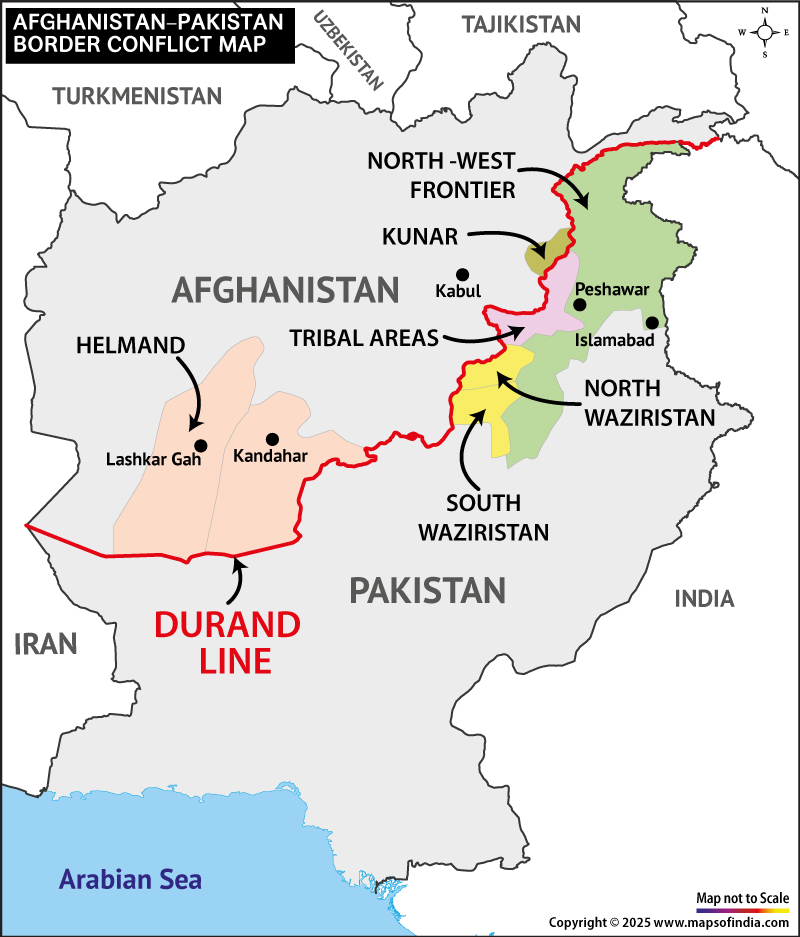
The deeper structural issue is the unresolved status of the Durand Line, the 1893 boundary drawn between British India and Afghanistan. The line divided Pashtun tribal territories, creating a long-standing grievance in Afghan political thought.
While Pakistan treats the Durand Line as an internationally recognized border, successive Afghan governments, including the Taliban have historically resisted formal recognition. The border cuts across ethnic Pashtun communities, and cross-border movement remains deeply embedded in local identity and trade patterns even to the extent of marital ties.
It is simplistic to frame the Taliban purely as an “Islamic force.” While Islamist ideology is central, the movement is also heavily rooted in Pashtun social structures and tribal superiority.
Strategic Miscalculations
Pakistan may have assumed that ideological affinity and past cooperation would ensure loyalty from the Taliban regime. However, sovereign governments ,even ideologically aligned ones, act in perceived national interest.
Several developments complicate Islamabad’s expectations:
The Taliban seek international legitimacy and resist appearing subordinate to Pakistan.
Afghanistan has cautiously diversified diplomatic engagements, including limited outreach to regional actors.
Domestic instability in Pakistan in the spheres of economic crisis, political polarization, and rising militancy have significantly reduced Islamabad’s leverage.
Pakistan’s military leadership ie: FAILED MARSHAL (not field) Asim Munir, has time and again deflected internal security under the garb of conspiracy of neighbouring nations. However, externalizing internal security crises risks diplomatic isolation at international level and further instability.
MidNight Operations and Irony in DayLight
The timing of strikes (late night) during Ramadan has also amplified symbolic outrage in Muslim-majority societies. Ironically, Bilawal Bhutto, the brat who speaks Urdu with an UK-accent, which would get a chuckle from even a deaf person, criticised Bharat for night-time military operations during OPERATION SINDOOR.
THE CHINESE ANGLE
The China-Pakistan Economic Corridor, the most prominent arm of the Belt and Road Initiative, runs through Pakistan’s most volatile regions. What was envisioned as a corridor of connectivity now sits exposed to the realities of cross-border militancy and political instability. For Beijing, the Pakistan–Afghanistan fault line is no longer merely a security irritant, it is an economic vulnerability.
Escalation between Islamabad and Kabul threatens not just tactical security but long-term viability. An expanded conflict zone risks turning infrastructure routes into liability zones. More significantly, Afghanistan was always viewed in Beijing as a potential future extension of regional trade connectivity by linking Central Asia to the Arabian Sea. Persistent instability along the frontier erodes that possibility.
A destabilised Afghanistan complicates investment security, weakens corridor credibility, and introduces uncertainty into the broader Belt and Road framework. This places quiet pressure on Islamabad: security responses that trigger wider instability may ultimately undermine the very strategic partnerships Pakistan seeks to leverage.
The BHARAT-PAKISTAN Chessboard

The shifting regional balance further complicates Islamabad’s calculus. Pakistan’s Afghan policy has long been informed by the fear of Indian encirclement. The Taliban’s return to power was initially seen as a strategic correction, an opportunity to limit New Delhi’s presence in Kabul.
Yet India has cautiously re-established channels of engagement with Taliban authorities, focusing on humanitarian assistance and diplomatic contact. While limited in scope, this outreach signals something more consequential: the Taliban’s willingness to maintain strategic autonomy.
It is therefore neither surprising nor irrational that Afghanistan has explored avenues of engagement with India. During the COVID crisis, New Delhi stepped forward through its Vaccine Maitri initiative by supplying vaccines, medical aid and essential humanitarian assistance at a time when Afghanistan’s public health system was under severe strain. For many Afghans, this was not abstract diplomacy but tangible support delivered in a moment of vulnerability.
By contrast, Pakistan’s own leadership has acknowledged the constraints under which it operates. In January 2026, Prime Minister Shehbaz Sharif shamelessly admitted that he and the country’s military leadership “feel ashamed” when compelled to travel abroad “begging for money.”
For Kabul, the strategic implication is evident. A state seeking policy autonomy is unlikely to rely exclusively on a partner whose economic space is itself externally bankrolled and wants Afghanistan to be it's vassal state.
Internal Deflection or External Necessity?
One recurring pattern in Pakistani politics is the tendency to attribute internal security challenges to external actors. Critics argue that blaming Kabul for TTP resurgence overlooks structural governance gaps within Pakistan’s own tribal districts and border management failures.
At the same time, Afghanistan’s inability or unwillingness to curb TTP activity is a genuine security concern for Islamabad. The reality is likely a mixture of both internal governance deficits and cross-border militant sanctuaries.

Conclusion
Historically, Afghanistan was the only country to oppose Pakistan’s admission to the United Nations in 1947 due to the Pashtun-istan issue. Decades later, mutual suspicion persists despite periods of tactical cooperation. If both sides continue escalation cycles without structured negotiation mechanisms, the Durand Line may transform from a disputed colonial boundary into an active fault line of conflict.
The future of Pakistan–Afghanistan relations will depend not on shared religious identity, but on whether both states can reconcile security concerns with sovereignty, ethnic realities, and humanitarian constraints.
From The Young British Soldier:
“When you're wounded and left on Afghanistan's plain. And the women come out to cut up what remains, Just roll to your rifle and blow out your brains”
History has never been kind to those who mistake Afghanistan for a subordinate frontier.
Rudyard Kipling’s grim warning was not merely poetry; it was prophecy. Afghanistan not conquered by night raids, airstrikes, or strategic assumptions. It absorbs pressure, endures, and outlasts. The lesson is simple. Pakistan celebrated the American withdrawal as a strategic victory. Yet today, it confronts a reality far more complex than triumph.
THE END


Comments