


Avengers of Politics , Assembling for Unity - A Speculative Game

After the electoral success in Karnataka state, Congress decided on the CM Oath Ceremony as a platform to show the strength of opposition unity with Bihar CM Nitish Kumar, NCP President Sharad Pawar, National Conference President Farooq Abdullah , Tamil Nadu CM MK Stalin , Jharkhand CM Hemant Soren , PDP chief Mehbooba Mufti , CPI(M) General Secretary Sitaram Yechury and CPI General Secretary D Raja being present at the ceremony.
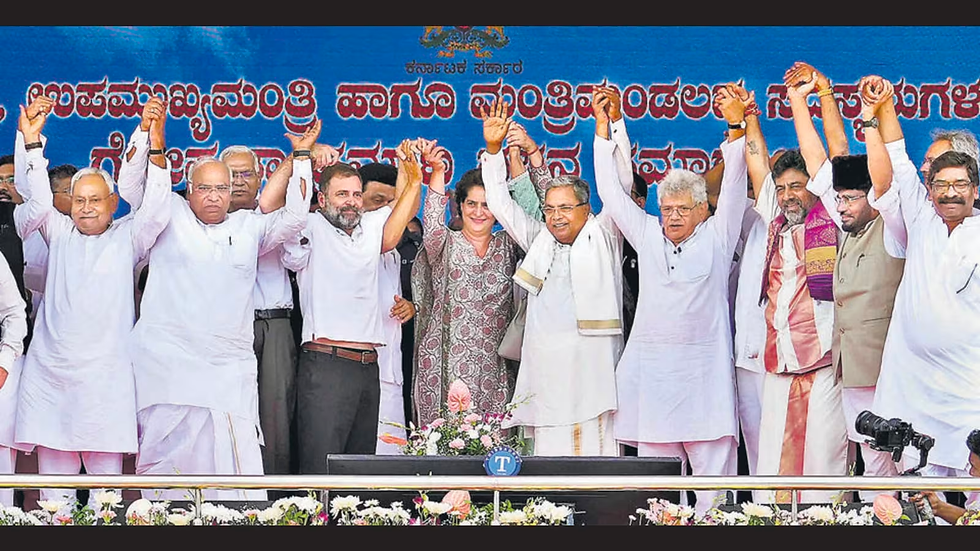
With less than 1 year before the 2024 Loksabha Elections - All the opposition parties seem to forge an alliance with the highly ambitious mission to take down the current NDA-led government. This reminds us of their previous failed attempt to work as a collective unit - A similar show of strength was shown when the Congress and JDS formed an alliance in Karnataka to form the government back in 2018 and kept the BJP out of power despite it emerging as the single largest party.
The new torch of opposition unity is being led by Bihar CM Nitish Kumar who is meeting non-BJP leaders across party lines to structure a opposition coalition. Delhi CM Arvind Kejriwal has asked for opposition unity to fight against BJP. Telangana CM K Chandrashekar Rao says he is ready to sponsor the enormous financial burden to fund the campaign of the opposition front. Sharad Pawar has supported this concept.
But, the problem is that they are not uniting for the public good , this is an alliance for desperately-wanting power. INC is structurally and electorally depleting day by day,
Arvind Kejriwal wants support for Manish Sisodia's arrest and the recent Delhi Ordinance passed by the Central government. Sharad Pawar who has joined hands for unity , was criticising Rahul Gandhi who tried to confront the govt. over their relationship with Adani-Ambani and opposed Joint Parliamentary Committee over the Adani-Hindenburg row. Nitish Kumar , the so-called torch-bearer wants a comfortable position in DELHI but failed to fulfil his presidential ambition. As a result , the next month after the presidential elections - he revoked his party from the NDA and broke the alliance with BJP in Bihar.
Will Congress even entertain Arvind Kejriwal who has snatched the states where Congress was once strong ? - Delhi in 2015 , Punjab in 2022 , Gujarat in 2022 [one of the major reasons for INC's failure in Gujarat was due to the vote percentage they lost due to AAP's inclusion and electorally election becoming a triangular contest , leading INC to come out as a LOSER] and the recent Jalandhar Loksabha Seat by-polls [a safe seat for Congress from 1999
onwards ]
Sign of their Initial Commitment -
19 Opposition parties came together to oppose the inauguration of the new parliament building and declared their unanimous decision to boycott the inauguration ceremony. The ceremony is denounced as a "direct attack" on democratic values. This may not appear as huge but , let us remark on this " Big things have small beginnings"
Have a look at it -

Role of Congress -
Congress is the principal opposition party in Loksabha , with the success of the Bharat Jodo Yatra & their electoral success in Himachal Pradesh and Karnataka , the cadre's confidence has increased at an all-time high since 2019 - this is a similar kind of confidence shown by INC back in 2018 , when Congress won Karnataka , Rajasthan , Maharastra , Madhya Pradesh and Chattisgarh - they were overjoyed as they penetrated the Hindi heartland where the majority of the BJP voters reside. However , voters had their reservations regarding Congress under Rahul Gandhi and opined differently in the 2019 General elections.
But if we imagine a united front against the BJP , Congress should be the nucleus of this front and as Mamata Banerjee has a clear stand , in areas where the Congress holds significant influence, let Congress contest the battles. Others will extend our support However, it is essential for them to reciprocate by supporting other political parties as well. " "Strong regional parties must be given priority" - she said.
The problem with Congress is that it has a bad record in sharing seats with regional state parties and the new Congress under Mallikarjun Kharge doesn't believe in the theory of jr.
partner in a coalition as it did in the 2017 Uttar Pradesh Assembly Elections with Samajwadi Party [SP contested in 311/403 seats and INC contested in 114/403] - Congress will ask for more power , more seats and more authority after a good year for the party in 2023 and others will have to follow.
My Ironical Observation -
Congress which is likely to lead this front , is unable to unite its own leaders. For example -
Ashok Gehlot & Sachin Pilot in Rajasthan
T. S. Singh Deo & Bhupesh Baghel in Chhattisgarh
Siddaramaiah & D. K. Shivakumar in Karnataka
The Mamata Banerjee Question -

In 2021 , Mamata Banerjee was making regular trips from Kolkata to Delhi to start preparing for the next general elections - Following her consecutive triumph in West Bengal, Mamata Banerjee's stature at the national level had elevated significantly and was meeting different leaders to construct a united front. But lately , in 2022 - she started praising RSS - "The Rashtriya Swayamsevak Sangh is not all bad and that there are some good people in it." she started attending all the meetings chaired by PM Modi , which she earlier boycotted.
Mamata Banerjee has supported this Mahagathbandhan but was absent in all the key moments of showing the unity strength , with the most recent being the Karnataka swearing-in ceremony and her party's [TMC] equation with Congress is quite stormy. TMC contested the Goa elections , gaining 5.2 % vote share damaging the congress's vote bank - similar stories transpired in North-Eastern states. Also , Mamata Banerjee blames Congress for her losing the Nandigram seat during West Bengal Assembly Elections 2021 - she blamed INC for not contesting the seat , which helped BJP's Suvendu Adhikari win the seat with a narrow margin. She accused INC of having a "tacit alliance" with BJP for the Nandigram seat.
Real Formula for Opposition Unity to Succeed -
Coming up with a common minimum programme which basically serves as a guiding framework enabling collaborative governance despite ideological differences. With the coming of a united front , their ideology will not be identical but they should be similar , the type of governance model should have qualities of "Unity in Diversity" like our country , and this will cater to different sections of our society. [ but I think this is the least of their concern right now , as the voters are more interested in caste-based representation politics and freebies that are thrown towards them ]
State-specific alliances are needed , some tacit and others tactical , leaders have to keep their egos aside to contest the seats , and their party can win.
What history has taught us -
Let us end this with a story -

In January 1977, following the 18-month Emergency period, elections were scheduled for March. The opposition swiftly formed a new party called the Janata Party. They campaigned against the undemocratic nature of the rule and highlighted the excesses during the Emergency. The Janata Party secured a significant victory in the elections, winning 295 seats, driven by the anti-Indira sentiment prevailing at the time. However, the Janata Party's unity began to wane as it lacked direction, leadership, and a shared agenda. In less than 18 months, the Morarji Desai-led government lost its majority, leading to a split within the Janata Party. Ultimately, the Janata Party's downfall and loss of power demonstrated the challenges of sustaining unity and effective governance in the face of internal divisions. Janta Party's tenure was limited from 1977-1979.
What has this story taught us ?
Janata Party failed for several reasons:
Ideological Differences: Janata Party was a diverse coalition, comprising various regional and ideological factions. These differences often led to internal conflicts and disagreements, making it challenging to maintain unity and cohesive governance.
Leadership Issues: Janata Party lacked strong and charismatic leadership that could effectively manage the diverse coalition and navigate the complexities of governance. Internal power struggles and leadership disputes weakened the party's ability to govern effectively.
Coalition Dynamics: The Janata Party was formed as a coalition of disparate parties with differing agendas and priorities. The coalition partners often had conflicting interests and struggled to find consensus on important policy matters, leading to governance challenges and a lack of coherent decision-making.
Conclusion -
Nevertheless , this opposition front smells of desperation , driven by the political ambition of some leaders and their hate & fear for Narendra Modi. However , there is no ideological cohesiveness among the parties which they need to get rid of. I doubt that , I will not be incorrect in saying that it's not an opposition front but an anti-modi front. With the learnings of Janta Party , I hope the current opposition learns their setbacks
or as Sydney Harris , an American journalist said -
History repeats itself, but in such cunning disguise that we never detect the resemblance until the damage is done
Comments